Heroes and Villains: Why our beloved game’s media men should be next under the microscope

By TuttiFruttiBusDriver

The decision to offer Dundee FC a place in the SPL appears to offer a welcome release from the maelstrom of committees, board meetings and legal chicanery that has consumed the thoughts of many during this dreich Scottish Summer of sport. It offers an opportunity for fans of all teams to focus on summer transfer windows, pre-season friendlies, and, perhaps, foster a wee bit of cautious optimism about what the season ahead may bring. Maybe the dust will settle a little and we can concentrate on the football.

However, while it is undoubtedly healthier to look forward with positivity to the new season, it is necessary to get several things in order if this is not to become yet another missed opportunity to address the parlous state of the game. There are many issues that need looked at from a change point of view, none more so than the role of BBC Scotland’s sport department going forward.

The now notorious inability of a vast rump of the Scottish football media to ask questions of David Murray for fear of being banished from the vineyards, private jets and oak-paneled offices is an embarrassment that will haunt many hacks for as long as they continue to eke out an existence in the media. Many key players at the BBC were not immune from this. Similarly when Craig Whyte emerged from the shadows (with a questionable CV to boot) the prevailing practice of parceling up PR-swill while avoiding asking difficult questions continued. On the evidence so far, and with a few notable exceptions as detailed below, Charles Green hasn’t exactly getting the roughest ride either.

Image
Chick Young and Jim Traynor – Purveyors of questionable coverage?

It is arguable that the senior management at BBC Scotland’s Sportsound conducts a fundamental and radical review of the makeup of their broadcasting team for the forthcoming season. While some have enhanced their reputations with an honest and even-handed approach to the protracted saga (Jim Spence and Richard Gordon spring to mind) others, such as the laughably lightweight Chick Young and the deliberate mendacious Jim Traynor are surely redundant. Young’s grasp of the story is weak and ineffectual. Traynor, meanwhile, has brought nothing to BBC Scotland’s sports output bar a hectoring, bullying, sneering, doom-mongering style that has many listeners reaching for the off-switch.

Traynor can write what he likes in his newspaper (which given the latest circulation figures appears to be living on borrowed time ) but I am sure many license-fee payers resent his views being rammed down their throats in the sake of ‘parity’ or ‘balance’. A slavish desire to see the status quo remain purely out of self-interest has been has main contribution to the debate. Surely this propagandist has no place in a key forum for debate on the issues going forward?

Jim Spence and Richard Gordon, conversely, are notable for the way that they have made room for nuanced arguments. They have focused on complex issues, have tried to make sense of wildly conflicting information and synthesize it into something meaningful for the listening audience. They’ve asked the difficult questions, engaged widely with fans on social media and largely understood that fans are now better informed, more connected, and, with worthwhile opinions (compare that to the loathing of ‘internet bampots’ that you get from Traynor).

It is vital that all those with an interest in the future of Scottish football ensure that the mainstream media charged with holding authorities to account ask the questions that we want asked and provide informed analysis/opinions. Where the pundits are not fulfilling that role then others must be offered the opportunity. Punditry should not be a job for life, it should be determined by an ability to ask the right questions, no matter how uncomfortable those may be, and, a demonstration of sound interpretation of events. The days of the two-dimensional Traynor autocrat or the sycophancy of Young are gone. While social media has radically altered the media landscape by increasing connections, relationships, and, the democratisation of information, it is important that those in charge of the BBC Scotland Sports department fulfill their commitment to serve in the public interest. Weak scrutiny has failed us in the past; it should not be allowed to happen again.

We are all Neil Lennon?! We most certainly are not…

Hitthebyline reviews the spontaneous combustion of Neil Lennon

Image
Pushing the self-destruct button – Lennon at the centre of controversy

Congratulations to Neil Lennon for guiding his young Celtic side to the SPL title. What a fantastic achievement, and on the face of it, everything is rosy at Celtic. An average squad age of just 23, operating in a financially prudent manner, and looking forward to launching an attack on the Champions League next season. However, the headlines this season (aside from the financial crisis at Rangers) have been dominated by Lennon’s ill-tempered approaches to officials, when they could so easily have been about the positive aspects of the Glasgow club’s season.

This petulant and puzzling behaviour again reared it’s ugly head when Celtic suffered a 2-1 defeat to Hearts in the Scottish Cup Final. Of course Celtic and Lennon have the right to feel aggrieved at that penalty decision that was at best, ill-judged and at worst, downright ludicrous, but what the Hoops boss did next was quite unprecedented. In a national semi-final, with 50,000 eyes on him in the stadium, and several million more watching at home, Lennon took it upon himself to dash on to the pitch and confront the referee in an aggressive manner.

Treating this case in isolation, perhaps you could almost put it down to a freak loss of temper, but this is now the third incident in a matter of weeks, and it’s getting to the stage now where the Celtic support are having to watch the name of their great club being besmirched by the manager’s thuggish actions.

18th March, Celtic are denied a debatable penalty in the League Cup final. Lennon doesn’t like it. Lennon criticises the referee’s decision. Lennon is warned about his conduct. Celtic lose the match (and the Cup).

25th March, Celtic suffer two red cards in an Old Firm match. Lennon doesn’t like it. Lennon foolishly approaches the referee at half-time. Lennon is reprimanded. Celtic lose the match.

15th April, Celtic concede a dubious penalty in the Scottish Cup semi-final. Lennon doesn’t like it. Lennon gives the ref a mouthful. Lennon will be punished. Celtic lose the match.

See a pattern forming here?

Let’s say for the sake of argument that Celtic have fallen victim to poor officiating in the above matches. Let’s also again take each game on it’s own merit.

First up, the League Cup final. If Celtic require an injury time penalty at Hampden to draw level with a distinctly average Kilmanock side, then the manager has failed to motivate and organise his team to do a job.

Next up, two red cards in an Old Firm match. Lennon decides to drop Kelvin Wilson for this match after a poor performance in the cup final, only to bring in one of the biggest bombscares I’ve ever known in Cha Du Ri. Cha’s sending off was by far the more suspect looking of the two but you’ve got to ask yourself some key questions. Why would this below-par player even be on the field? And why did he allow himself to be caught so far up the park, when Celtic had fielded a 5-man midfield? As much as the decision was a joke, I’m firmly of the opinion that Cha shouldn’t have been anywhere near the team, and even if he was, then he should have the savvy as a professional football player to be able to conservatively hold the right-back position as part of the 4-5-1 tactic deployed. Wanyama’s red card is unquestionably deserved. Two-footed tackle off the ground is a straight red any day of the week. Yet still, Lennon makes a fool of himself by challenging the referee in the tunnel at half-time (something we all know isn’t allowed).

Finally, and most recently, another Hampden park non-event for Celtic. It took Lennon’s Celtic over 35 minutes to register a single shot on target, despite admittedly dominating the game. The longer the match went on, and with Ki hitting the post from close range twice, the match was always going to swing in the Gorgie club’s favour. As previously discussed, perhaps Celtic shouldn’t have had a penalty given against, then, but the fact is that Celtic should have done more to win the match. Many of Celtic’s top players didn’t turn up. Of course Ian Black should have been sent off for that horror tackle on Joe Ledley, and the officiating standard was poor, but at which point was Lennon going to mention the fact that Hooper’s equaliser could have been given as offside?

As if the aggressive confrontation to the officials wasn’t embarrassing enough, the Celtic manager then took to Twitter. Why Celtic’s manager engages actively in social media at all is beyond me. I’ve long cringed at his interaction with what are clearly adolescent teens and ill-informed, angst ridden punters who’re partial to making a call to football phone-ins. His comments via this medium have often been knee-jerk, but Sunday night’s tirade of nonsense was a new low.

For those of you who may have missed it, the Celtic boss indicated that he felt his side had received a disproportionate number of ‘dodgy’ decisions in big games, and these latest ones were “personal”. What a myopic and ill-thought out reaction. There are so many statistics and incidents to counter his argument that I don’t know where to start, but a good place could possibly be the last time Lennon’s men met their Scottish Cup opponents at Tynecastle earlier in the season. Hearts, as we all remember, were denied a clear goal against Celtic early in the match on this occasion, before Celtic went on to score at the other end, and ultimately hammer the Jam Tarts 4-0. Was this officiating blunder “personal” too?

To avoid the inevitable accusations that I’ll be faced with for being selective in my use of facts, let’s look at the penalty awards in the SPL, for this season and last.

2010/2011 season – Which team do you think were awarded the most penalty kicks? Yes, you’ve guessed it. Celtic, with 13 penalties. That same season, Celtic also conceded the fewest penalty kicks. This season, although obviously not finished yet, the Bhoys have again conceded the fewest penalty kicks.

So where’s the conspiracy? Where’s the clandestine collusion? Or is it all just hokum from a paranoid manager with a persecution complex?

Lennon has faced things off the park that no professional, and no human should have to endure. For this reason I retain a modicum of respect for Lennon, solely because he stood up to the bigots and didn’t allow his dreams to be taken from him, but his increasingly bizarre behaviour indicates to me that this job in the goldfish bowl that is Scottish football is an unsuitable one for a clearly unstable individual.

Always a fiery individual during his playing days, but I’m struggling to see why he can’t recapture the discipline that saw him play at the highest level. Lennon’s actions have repercussions not only for himself, but for the club’s reputation, and the next generation of Celtic fans. It seems like a lifetime ago when Lennon was an integral part of the team that made it all the way to Seville, playing “the Celtic way” and winning thousands of plaudits from all over Europe. Celtic were the likeable sleeping giant of European football, with a fanbase that were clean-cut and fun-loving, so much so that they received the FIFA Fair Play award that year. What must those one-time appreciators from all over the continent thing when they see the manager of the famous Glasgow Celtic behaving like a common thug? The fan-base too are in danger of being reeled in by this persecution complex. The “them and us” tribal mentality from bygone years looks as though it could be returning in the minds of many of the more impressionable Celtic fans.

I’d sincerely hope that this doesn’t continue to creep into the Celtic support. Sunday also showed that poor officiating isn’t just a Scottish problem. South of the border a match was decided by a horrendous mistake from the guys calling the shots. Spurs could potentially have lost out on silverware too as a result of Juan Mata’s goal that never was for Chelsea. After the match, did ‘Arry Redknapp (not that he’s fit enough to) dash across the park in pursuit of the referee to vent his anger? No. He also didn’t bring the game into disrepute by insinuating that a conspiracy was behind his side’s failure to capture points from the match. Instead he spoke calmly to the media, and backed the inevitable introduction of goal-line technology. Altogether, a more classy approach to an officiating failure where more was at stake for his men.

There’s so much going for Celtic at the moment, so why do the support and the likes of Lawell tolerate idiotic behaviour from the manager. The fans wouldn’t tolerate this nonsense from Martin O’Neill, Wim Jansen, Gordon Strachan, or anyone for that matter, so why does Lennon get away with it.

It’s time for Neil to hold his hands up when he loses in big matches. It takes a big man to say, “I got it wrong on the day” or “the best team won.” Lennon needs to focus on being the manager of Celtic football club, before his actions make his position at the club untenable. Time to shape up or ship out.

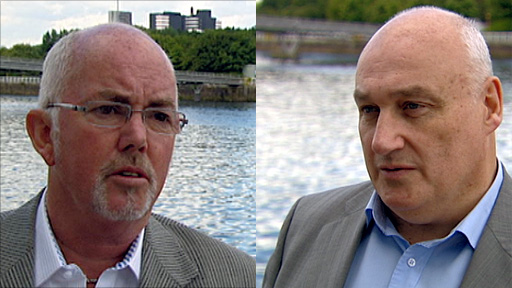
EXCLUSIVE : Scottish multimillionaire mulling over Rangers takeover

On a day that will go down as one of the darkest in Rangers’ history to date, Hitthebyline can reveal what could prove to be a shining light at the end of a tunnel of turmoil for the club.

A Hitthebyline insider has had advanced discussions with Jim McColl OBE, who has expressed a desire to end the disastrous reign of Craig Whyte.

Jim McColl - Scottish Multimillionaire
Jim McColl - The saviour of Rangers?

Last month, McColl was mentioned by former Rangers director Paul Murray as being a key figure in a potential consortium to mount a takeover bid. However, it would seem since then that McColl has had a change of heart, and would now like to champion the takeover on his own, (as our insider learned at the weekend while speaking to him at a local golf outing).

McColl is understood to be watching intently and mulling over his options as he looks to become the successor to Craig Whyte, and ultimately end the suffering of the Ibrox faithful.

The Carmunnock born businessman has a reported fortune of over £800m, with a far more transparent and upstanding reputation than the clandestine Mr Whyte. The Daily Record reported in November of 2008 that McColl had overtaken Tom Hunter as Scotland’s richest man, and with recognition in the Queen’s Birthday Honors list of 2001, Rangers would be inclined to put to put their faith in the seemingly upstanding businessman, should any takeover bid emerge.

As a lifelong Rangers fan, McColl has long been rumoured to enter into financial involvement with his boyhood heroes. In 2010, the Sunday Herald also reported that he was to be the bankroller of a Rangers Supporters Trust takeover bid, which was to make the club wholly owned by the supporters (in a similar setup to how Barcelona currently operate). This has since proved to be not entirely true, but the multimillionaire conceded to the fact he was providing financial advice to the supporters trust.

In this age of uncertainty for the Glasgow giants, it remains to be seen whether the successful entrepreneur will firm up his interest in the club. With his interest in the club now declared, all eyes will now be on him to see when and if he takes the next step.

A World Without Rangers?

Hitthebyline proudly presents our latest contributor, Edward Champagne. In “A World Without Rangers?”, Edward explores the potential pro’s and con’s of Rangers’ hypothetical expulsion from the SPL, given the problems that could ensue as the HMRC tax case draws to a conclusion.

By Edward Champagne

Image

As Rangers continue to wallow in the perpetual mire thrust upon them by the HMRC tax case and financial misery, one could be excused for beginning to ponder exactly how Scottish Football would be affected by the loss of one of its most successful and well supported teams.

In recent times Scottish football has been dominated by both Celtic and Rangers, with every SPL title since the league’s inception in 1998 having been won by one of the two Glasgow giants. This, however, hasn’t always been the case. In the 80’s both Sir Alex Ferguson’s Aberdeen and Jim McLean’s Dundee United won the league title. Who could also forget the memorable 1985 season? – When Alex McDonald’s Hearts side were pipped to the post by Davie Hay’s Celtic
Alex McDonald’s Hearts came so close in 1985 only to be pipped on the line by Davie Hay’s Celtic with the assistance of Dundee’s Albert Kidd.

The question on many fans’ lips in recent weeks is how would Scottish football fair if a Rangers “phoenix” club were not allowed to pick up the SPL licence from the club in administration and to continue to play in the Scottish top flight. Many argue that the loss of TV revenue provided by the Sky TV contract, and the reduced gate receipts would force SPL chairman to accept the new phoenix club back into the SPL, with at worst, a points deduction as punishment.

So for that reason it’s worth looking at the revenue available to SPL clubs. All revenues generated by the SPL in respect of TV, Radio and sponsorship are effectively put into one big pot. A support payment to the SFL and parachute payments to assist relegated clubs are then deducted from that pot.

The money left in the pot is then split to provide each club with 4% of the total revenue based on league participation and with the rest subsequently awarded to the club depending on their league position. The bonus system is heavily weighted towards the teams finishing as SPL winners and the team in the runners up position, with 32% of the overall budget going to these clubs.. Only once in the SPL existence have these slots failed to be filled by Celtic and Rangers when Hearts managed to knock Rangers into third position in season 2005/2006.  In season 2007/2008 which was ironically the last season were a SPL member club in Gretna went out of business, the SPL had £18m to distribute amongst its member clubs. It was split in the following manner:

Club SPL Revenue
Celtic £3.06m
Rangers £2.70m
Motherwell £1.71m
Aberdeen £1.53m
Dundee Utd £1.44m
Hibs £1.35m
Falkirk £1.26m
Hearts £1.17m
Inverness £1.08m
St Mirren £0.99m
Kilmarnock £0.90m
Gretna £0.81m

The table shows that although Celtic and Rangers shared 32% of the budget, the SPL commercial revenue split doesn’t explain the financial gulf between the big two and the rest of Scottish football.  This is more explained by the average attendances and commercial power that the Glasgow clubs have over their rivals and the fact that they are the only ones to ever receive the UEFA Champions League bounty. In season 2010/11 both Celtic and Rangers had 3 times more paying fans on average than nearest rivals Hearts.

Club

Average Attendance in 2010/11

Celtic

48968

Rangers

45305

Hearts

14185

Hibernian

11756

Aberdeen

9129

Dundee Utd

7389

Kilmarnock

6427

Motherwell

5255

Inverness CT

4526

St Mirren

4450

St Johnstone

3841

Hamilton

2898

The SPL board made up of Ralph Topping (SPL Chairman), Neil Doncaster (SPL Chief Executive), Eric Riley (Celtic FC), Stephen Thompson (Dundee United FC), Derek Weir (Motherwell FC) and Steven Brown (St Johnstone FC) have to decide what punishment the Rangers phoenix club should endure although the first penalty would be taken out of their hands by parent association UEFA.

UEFA rules do not allow a club who has faced financial administration to participate in any of their European competitions for a period of 3 years. This UEFA financial Fair Play ruling was the reason that Harry Rednapp’s Portsmouth were not allowed to participate as an English representative in the UEFA Cup following their FA Cup win in 2008. This would mean that an extra SPL club would have the chance to gain a European place and the associated revenue which they maybe would have seen as beyond their reach

So the SPL Board have to decide if they want to punish Rangers with or without  a points deduction and grant the transfer of the league licence to play in the SPL or make the phoenix club start again at the bottom of SFL Division 3.

In the scenario that Rangers are demoted to Division 3, it would seem given Celtic’s financial advantage and recent points finishes in comparison to other SPL clubs I think it’s fair to say that they would start as overwhelming favourites to win the SPL but how could other clubs try to bridge the gap whilst Rangers worked their way back up the leagues? Increased attendances? Higher league finishing positions bonus?

When you take into account the limited SPL commercial revenues listed above it would seem that they couldn’t be used to bridge the massive revenue gap especially with a reduced TV contract caused by the lack of the 4 Old Firm TV games so attendances would need to drive the revenue increase.  A look at recent attendances in the SPL show little fluctuation amongst top six clubs e.g. Hearts figures show that regardless of league position they finish somewhere between 14 to 16 thousand and its unlikely they would increase beyond 20 thousand even with the potential of 2nd place.

If we look back to when the Old Firm didn’t dominate Scottish football in season 1983/84, the crowds were not dissimilar to the ones that some clubs are achieving now. This was despite the fact the Aberdeen were holders of the European Cup Winners Cup and their fans had recently seen them defeat the European giants of Real Madrid and Bayern Munich.  Scottish football fans of a certain vintage will also remember the excellent Dundee Utd team of the time who were the league champions and had exciting times in Europe beating Barcelona in the Nou Camp and reaching the Uefa Cup final against Gothenburg.

It would seem that for the other teams in Scottish football success would bring increased supporters no doubt but their average attendance would always have a ceiling due to their demographic. When you take into consideration the difference in football now and the absence of live TV the average attendances at the time are quite surprising

Average attendances 1983/84:

Rangers – 21,996
Celtic – 18,390
Aberdeen – 17,138
Hearts – 11,914
Dundee Utd – 10,894
Hibernian – 8,334
Dundee – 7,442
Motherwell – 5,566
St. Mirren – 4,900
St. Johnstone – 4,859

I think everyone in Scottish football would love to see the return of a competitive SPL and have teams from all parts of the country challenging for honours but this looks, given the evidence, to be wishful thinking. Football has changed dramatically since Aberdeen, Dundee United and Hearts were able to challenge the Old Firm and the financial gap is surely too large to bridge given the SPL winner each year would only move further away with the potential of Champions League money.

In summary, a large proportion of SPL fans will agree with the feelings of many Celtic fans that during the well documented period of Rangers’ financial mismanagement, the Ibrox club had an unfair spending advantage, and as such should be punished by the football authorities. The question is however, would that punishment be best served by demoting Rangers into Division 3?

There is no doubt that the dominance of the Old Firm in Scottish Football has caused the competition to become stale and I for one think the other teams would quite enjoy a shot at 2nd or 3rd place if only for 3 seasons. The new Rangers 2012 club clear of debt and with the sizeable support would inevitably return up to the SPL and return it back to a sense of normality in three seasons. One negative facing the SPL chairman would be the loss of 2 potential visits by Rangers to their ground for 3 seasons. However, this would only effect top six finishing clubs and in recent years only Hearts have enjoyed anything close to a full house with a game against Rangers so there is the potential to plug this gap with increased crowds due to their own team performance

The punishment to place Rangers in Division 3 will not change Scottish football dramatically and return it to past glories but it will give the other clubs a chance to compete for the reward of top places finishes, the chance to compete in Europe , give Scottish football a time to cool down with the absence of 4 Old Firm games a season and most importantly maintain sporting integrity

Aluko’s the man to keep Gers in the Hunt

Rangers fan Ewan McQueen explains why Sone Aluko could be an unlikely hero for Ally McCoist’s men

In the beginning...

It’s fair to say that since his arrival at Rangers in November, Sone Aluko has rarely been far from the headlines in the world of Scottish football. Even before his arrival, Aluko was surrounded by controversy as rumours flew around the Scottish media world that the former Aberdeen star had paid for his move to Rangers out of his own back pocket. Whilst there was conflicting reports over that, most Rangers fans including myself were pleasantly surprised to see Aluko at the club. Yes, it was a gamble that was being taken by manager Ally McCoist, but on a personal level, I always rated Aluko at Aberdeen. His trickery and eye for goal was impressive; but others did label him as lazy and inconsistent. Having lost Steven Naismith to injury a few weeks earlier, in a match against Aluko’s former club Aberdeen, McCoist recognised he needed someone to give his team the energy and drive that Naismith had provided in the first few months of the season.

Whilst Aluko was and never is going to be a like-for like replacement for the Scotland star, everyone associated with Rangers could clearly see that since Naismith’s injury, the Ibrox side had been extremely sluggish and devoid of ideas. Three days after signing, Aluko was thrown in from the start against Kilmarnock, where he showed in glimpses what he could bring to the team. During the first half in particular, he attacked the Kilmarnock defence and just before half-time was arguably denied what looked to be a stonewall penalty. However, he was to play a significant role in handing Kilmarnock a 1-0 victory and condemning his new side to their first SPL defeat of the season. As Kilmarnock put the ball back into the box, Manuel Pascali headed home from what looked an offside position, but infact Aluko had failed to rush out the box along with his teammates, therefore the goal stood.

This spoiled what was otherwise a very good debut by Aluko. The following week against Dunfermline, the Englishman was yet again at the centre of the action. He showed in patches what he could bring to the Rangers team over the course of the season. This was shown when he attacked the Dunfermline defence and won a penalty which was duly converted by Nikica Jelavic. However, after the match Aluko was found guilty of diving to win that aforementioned penalty and was banned for Rangers next two games.

Despite Rangers winning their next two games, Aluko’s absence was keenly felt. Against Hibs and Inverness respectively, Rangers were once again devoid of ideas and energy just as they had been before Aluko’s arrival at the club. The match against Terry Butcher’s men was torturous viewing and Rangers really got out of jail with a winner from Kyle Lafferty in the 83rd minute. Already Rangers fans could see that Aluko was a big player for them in an attacking sense. I don’t wish to gloss over the Christmas period defeats to St Mirren and Celtic that Rangers suffered, but in these games avoidable red cards and errors in defence were the reasons for Rangers surrendering their lead at the top of the table.

Once again though, Aluko showed that he was just about the only player in the Rangers team with perhaps the exception of youngster Gregg Wylde that was willing to run at opposition full-backs. Indeed, his cross in the Glasgow derby game that picked out Lee Wallace almost gave Rangers an early lead. But it has been in the first three games of 2012, where Aluko has taken his game to a new level and really stamped his influence on the Rangers team.

In the first match of the year against Motherwell, Aluko scored his first goal for the club and produced an all-round display that regularly got fans out of their seats in admiration and he was a constant menace for the Motherwell defence. Next up was a tie against Arbroath. Perhaps routine on paper, but Rangers were yet to win a cup game under McCoist and needed to avoid a further embarrassment. Aluko was key to doing this and his shining moment was when he showed great skill to set up Jelavic for a killer third goal.

And last weekend against St Johnstone, he was once again the key man for Rangers. He set up Jelavic for both his goals; one a bursting run into the box and the other a superb free-kick delivery. And once again he tormented the Saints fullbacks with his level of skill, pace and trickery and this made sure Rangers saw out a vital 2-1 victory in Perth. Despite a lacklustre draw most recently against Aluko’s former club, again the Nigerian looked lively and was a shining light in an otherwise dark and dank Rangers line-up.

Some would argue that keeping Nikica Jelavic at the club (however unlikely that may seem), as well as Allan McGregor and Steven Davis will determine whether or not Rangers are to secure a fourth SPL title on the spin, but perhaps it’s not as clean cut as that.

It’s no mean feat to endear yourself to the Ibrox faithful, yet Aluko has managed this in no time at all. He’s had little or no time to settle, and I for one believe, particularly at such a young age, that Aluko’s form could be the paramount factor in Rangers’ title hopes this season, and for seasons to come.

Agree with Ewan? Got a point to make about this piece? Leave a comment below.

Got a point you’d like to make on Hitthebyline.com? – Email hitthebyline@yahoo.co.uk with your idea

The Jelavic Effect

Why Rangers can’t afford to sell Nikicia Jelavic

By Johnny Connelly

Image

Given the financial difficulties facing current SPL champions Rangers, football fans from up and down the country have been speculating ‘where’ and ‘when’ rather than ‘if’ talisman Nikica Jelavic will be departing the club. During the transfer window, it’s open season for ‘red-top’ journalists to pen tales that’d be more suited to Jackanory than the back pages of their downmarket publications. Before the transfer window even opened, Rangers fans have been conditioned to believe that their most prized asset will be headed for the exit. However, after a little statistical analysis, to my mind Rangers have no option but to retain the services of their leading scorer.

Look familiar? This is the SPL table as it stands:

Pl

W

D

L

Points

1 Celtic

23

18

2

3

56

2 Rangers

23

17

3

3

54

3 Hearts

23

10

5

8

35

4 Motherwell

21

10

4

7

34

5 St Johnstone

22

9

5

8

32

6 Kilmarnock

22

6

9

7

27

7 Dundee Utd

23

6

8

9

26

8 St Mirren

23

6

8

9

26

9 Aberdeen

23

6

7

10

25

10 Inverness CT

22

6

4

12

22

11 Hibernian

22

4

6

12

18

12 Dunfermline

21

3

5

13

14

Currently, the SPL title look as though we could be in for another nail biting crescendo at the end of the season. Celtic hold a narrow lead at the top of the table, and Rangers’ are close behind. Everyone knows that Rangers’ title challenge so far has leaned heavily on the abilities of the aforementioned Nikica Jelavic.

So where would Rangers be currently without Jelavic? This is hard to determine. He’s scored 14 goals in the 23 matches the Gers have played so far this season, as well as providing several assists. Let’s take a look at how things would look if we remove the contributions of the former Rapid Vienna hitman. Of course Rangers would have had another player in Jelavic’s place who’d have impacted positively on the team, but for argument’s sake, let’s deal with the cold hard facts of Jelavic’s impact on the SPL this season.

After reviewing in detail, each of Rangers’ 23 SPL encounters this season, it turns out that Jelavic’s contributions have been critical in gaining points on 7 occasions.

Date Opposition Result Result without Jelavic Jelavic Impact Point Shift

15/10/11

St Mirren @ Ibrox 1-1 Draw 1-0 Defeat 1 Goal – 48th minute

-1

29/10/11

Aberdeen @ Pittodrie 2-1 Win 1-1 Draw 1 Goal – 70th minute

-2

05/11/11

Dundee United @ Ibrox 3-1 Win 1-1 Draw 2 Goals – 19th & 63rd minute

-2

03/12/11

Dunfermline @ Ibrox 2-1 Win 1-1 Draw 1 Goal – 29th minute

-2

10/12/11

Hibs @ Easter Road 2-0 Win 0-0 Draw 2 Goals – 61st & 69th minute

-2

17/12/11

ICT @ Ibrox 2-1 Win 1-1 Draw 1 Assist – 55th minute

-2

14/01/12

St Johnstone @ McDairmid Park 2-1 Win 1-0 Defeat 2 Goals – 24th & 81st minute

-3

Total

-14


 How would this affect the current table? Take a look:

Pl

W

D

L

Points

1 Celtic

23

18

2

3

56

2 Rangers

23

11

7

5

40

3 Hearts

23

10

5

8

35

5 St Johnstone

22

10

5

7

35

4 Motherwell

21

10

4

7

34

7 Dundee Utd

23

6

9

8

27

6 Kilmarnock

22

6

9

7

27

8 St Mirren

23

7

7

9

28

9 Aberdeen

23

6

8

9

26

10 Inverness CT

22

6

5

11

23

11 Hibernian

22

4

7

11

19

12 Dunfermline

21

3

6

12

15


Of course, just to reiterate, this is all a hypothetical worst case scenario for Rangers, but it does make for interesting reading. Rangers are not alone in their heavy dependency on one or small number of players. (i.e Celtic – Hooper/Stokes, Barcelona – Messi, Arsenal – Van Persie, Man Utd – Rooney etc)

Perhaps coincidence, but perhaps not, that 6 of the 7 crucial Jelavic matches occurred after Rangers lost Steven Naismith for the season to that horrific injury against Hearts. This would imply that Jelavic has stepped up to the mark and carried Rangers through, again highlighting his paramount importance to the team. This poses the question, who, if anyone at Rangers could step up to the mark to replace Jelavic?

Rangers have been fortunate in recent years, that when they’ve lost a prolific goal scorer, another one has emerged from within the squad. After Kris Boyd moved on, Kenny Miller couldn’t stop scoring. When Miller was sold, in stepped Steven Naismith and latterly Nikicia Jelavic.
But who, in a such a threadbare Rangers squad, could step up to fill Jelavic’s boots? – Lafferty? Healy? (Really?)

The names that have been thrown around as potential replacements for Jelavic are unlikely to fill the Ibrox faithful with much hope. The return of an overweight and out of touch Kris Boyd or Nacho Novo is not what the fans want, or the team needs. Even the likes of Garry O’Connor, despite his impressive goal scoring record this season, has neither the prowess or finesse to replace Jelavic.

So in this myopic and seemingly inevitable shifting of Rangers’ top scorer to pastures new, I wonder if the money men at the club have considered weighing up the potential benefits of keeping him against selling him?

The benefits of keeping him are clear, having top-drawer goal scorer like the big Croatian in the team could be the difference between Rangers winning or losing the league. This in turn affects the chances of Rangers qualifying for the lucrative Champions League next season.

So what of the benefits of selling him? Transfer fees of between £7-£10m are being batted around, but in the grand scheme of things, does that money really dig Ally McCoist’s men out of any kind of trouble? Supposing Rangers do flounder in the conclusion of the HMRC tax case, and end up owing the tax man in the region of £50m, does selling your star man to pay off just a fraction of a mammoth debt seem like shrewd business? For me it doesn’t.

To my mind, Rangers currently have 3 top drawer players in their team: Alan McGregor, Steven Davis, and Nikica Jelavic. Now, tax case or no tax case, if Rangers are to survive this difficult spell in their history, this solid core unit of players has to be kept together.

Even for Celtic fans, or fans of any other team in the SPL, the retention of Jelavic should be a concern. The SPL is constantly under fire for being poor in quality, with very few real stars. To lose yet another one to the Premiership or beyond would be a real kick in the teeth. Obviously scoring 30 times in 44 outings for Rangers is going to attract attention, but for the good of Scottish football, and their own future, the Ibrox club must fight valiantly to keep Jelavic.

As much as Celtic fans would love to see their side win the league, given the choice, would they rather beat a strong Rangers side, or a significantly weakened one? The classic Old Firm battles throughout they decades have been when both sides have been at their strongest, with a spattering of world class players dawning both famous jerseys. Although Jelavic perhaps doesn’t quite live up to the Gascoigne’s, De Boer’s or Laudrup’s of the past, he’s the best they have, and as such, is invaluable.

Only time will tell as Scottish football fans look on anxiously, peering through the smoke and mirrors of the Craig Whyte regime to see if he’ll hold on to Jelavic and try to steer Rangers to glory; or cash in on the player in order to make the club’s accounts look a little more robust.

Leave your thoughts below:  


How would the Old Firm fare in the English Premier League?

by Johnny Connelly

Image
How would this look South of the border?

For as long as Celtic and Rangers have held their seemingly relentless stranglehold on Scottish football, fans both north and south of the border have speculated as to how the Glasgow giants would handle themselves against the top clubs in the English Premiership. The Old Firm over the past decade to 15 years or so have regularly met with English opposition in European competition. These battles of Britain have rarely led to the Glasgow clubs taking a real heavy defeat, which does indicate that they can rough it up with the best, but how would the Old Firm do if English opposition was on the fixture list on a weekly basis?

The truth is we can only speculate, as there is little we can do to identify any kind of common denominator to allow a clear, direct comparison.

The first, well documented factor that puts the respective leagues at polar opposites in terms of stature is TV and prize money. Celtic or Rangers can expect a paltry £2.7m for winning the SPL title this year, while the teams who’ll suffer the cruel fate of relegation from England’s elite division can be comforted by a ‘parachute payment’ of £48m over 4 years. The same disparate revenue totals are echoed when it comes to TV money. The Old Firm will pick up a reasonable few million pounds per year for their troubles in the SPL; but some of the top English clubs are raking in up to £4.3m per televised game!

This almost embarrassing difference allows teams who’re far smaller in stature than Celtic or Rangers to make significant inroads in the transfer market. I’m sure all readers would unanimously agree that the Old Firm dwarf clubs like Bolton, Fulham, Aston Villa or Stoke to name but a few – but just look at the money these ‘wee English teams’ can throw at players.

  • Bolton sign David N’Gog for £4.5m
  • Fulham sign Bryan Ruiz for £12m
  • Aston Villa sign Charles N’Zogbia for £10.8m
  • Stoke City sign Peter Crouch for £11.3m

The Old Firm, and Scottish clubs in general can only dream of these budgets. The truth of this hits home when you see Dundee United, one of Scotland’s biggest clubs, bid a miserly £25,000 for Hamilton’s Dougie Imrie, without the means to increase their bid to capture the player’s signature.

Another prime example is the once legendary Fernando Torres. Chelsea splashed an exorbitant £50m on their misfiring striker; a fee that if levied to Rangers in the ongoing HMRC tax case could be enough to force the club into liquidation (hypothetically speaking of course).

I firmly believe that if given the lavish financial buoyancy aids that come along with the Premiership, the Old Firm would be a force to be reckoned with, but again, it’s just a speculative thought in the seemingly infinite cyberspace cosmos that is the football forums of Twitter, Facebook and social media in general.

So, an alternative means of comparison is necessary. An altogether more simplistic one. The crystal clear comparison created by the monitoring of clubs’ ability to put bums on seats.

In Scotland, England, and across Europe as a whole, for decades upon decades, the clubs with the highest attendance figures tend to celebrate more domestic success than those with smaller crowds. This direct correlation is not relative to circumstance, and does stand up to our cross border comparison.

Celtic and Rangers, despite the shocking state of Scottish football, are still pulling in crowds at a remarkable rate, so much so that the average gates would currently put Celtic and Rangers 3rd and 4th in the English Premier League table in this respect.

Team

Average Attendance

Stadium Capactiy

% full

Man Utd

74,864

75,769

98.8%

Arsenal

59,927

60,361

99.3%

Celtic

49,462

60,832

81.3%

Rangers

45,943

51,082

89.9%

Man City

45,513

47,805

95.2%

Newcastle

43,388

52,339

82.9%

Liverpool

42,864

45,276

94.7%

Chelsea

41,439

42,449

97.6%

Sunderland

40,355

48,707

82.9%

Aston Villa

38,573

42,783

90.2%

Everton

36,725

40,157

91.5%

Tottenham

35,794

36,230

98.8%

Wolves

28,366

29,303

96.8%

Stoke

27,162

27,500

98.8%

Norwich

26,515

27,033

98.1%

Blackburn

25,428

31,154

81.6%

Fulham

23,909

25,478

93.8%

West Brom

22,199

26,500

83.8%

Bolton

21,881

28,101

77.9%

Swansea

19,822

20,532

96.5%

Wigan

18,006

25,133

71.6%

QPR

17,024

18,360

92.7%

However, the statistics also bare out that Celtic and Rangers would see a significant rise in attendance figures if they ever did play in the Premiership. Looking at the SPL as a whole, on average, a whopping 43.6% of seats are empty. This figure is heavily skewed by the smaller clubs in the league; if we judge it purely on matches at Celtic Park and Ibrox, the empty seats figure shrinks to just 14.4%.

The story in the Premiership is somewhat different as you’d expect. Across the board in the EPL, you’ll find just 8.8% of seats are empty. If we assume that by playing in the Premiership, the Old Firm saw a similar level of ticket uptake (conservatively estimating the aforementioned calculated 5.6% increase between the leagues) the approximate average attendance at Celtic Park would jump to 52,232 with fixtures at Ibrox being 48,007. These figures put the Glasgow clubs even further afield of the likes of Manchester City, Newcastle, Liverpool, and Chelsea; but still considerably short of Manchester United and Arsenal at the summit of the Premiership. Surely it’s more than just a coincidence that those clubs with the highest attendance figures are the clubs who, buy in large, are fighting it out for the illustrious crown that is the English Premier League title?

Supposing entry was ever granted to the Premiership, Celtic and Rangers would be given an equal share of the over inflated TV money, putting them on an even financial playing field with the rest of the teams. This would make the Glasgow clubs a much more viable option for the top players in Europe and beyond, as the Old Firm could engage in an evenly matched bidding war with any of the other English Premiership club, with the added draw of the huge crowds, legendary atmosphere, adoring fans, and largely incomparable history.

The international brand identity and marketable commodity that Celtic and Rangers possess perhaps may not be as grand in scale as Manchester United or Liverpool currently; but it dwarfs the bottom 10 clubs in the Premiership, and is at least on a par with the likes of Manchester City, Chelsea, Spurs, and Arsenal in my opinion.

Given the opportunity to compete in what’s billed as ‘the greatest league in the world’ by many, would see the Glasgow clubs (after a few years of bedding in) replicate the attendance table positions in the actual league standings.

The Old Firm have everything that a global footballing giant would need, except the financial galvanising that a league like the Premiership offers. The remarkable history and the passion of the adoring fans who turn out in phenomenal numbers, together with the abundant budgets that come as part of the EPL, would almost certainly see Celtic and Rangers challenge for honours with the very best England has to offer.

Sadly though, it’s not as simple and as straightforward as this. Now, and for the foreseeable future, Sky television hold all the cards in this stagnant game of poker. As the Scottish game continues to dwindle and the English game reaches financial saturation, we can but hope that those who call the shots at the television companies come to realise that the royal flush they’re in search of, lies north of the border in the heart of Glasgow.

Have your say – vote in the poll or comment below.

Have Rangers turned the corner after their Old Firm blues?

Hitthebyline introduces our latest contributor, Rangers fan Chris Mason. In his debut article for the site, Chris explores the optimistic notion that Rangers may well be back on the road to success after suffering a purple patch at the tail end of 2011.


Rangers Talisman – Nikica Jelavic


January is typically a depressing month, and this January is no exception, particularly for Rangers fans. After witnessing what seemed like an unassailable lead at the top of the SPL cut back due to an alarming loss of form, then losing top spot to Celtic in the festive Old Firm clash, there feels little to be cheery about. On top of this, there is the re-opening of the transfer window, where Rangers will be faced with the all too familiar daily speculation about the departure of our best players. Then there is the looming dark cloud that is the clubs ongoing tax battle with HMRC.

First let’s take a look the end of 2011. A poor run of results at the end of the year was difficult to take. So many key players seemed to be playing within themselves, in particular, the usually stellar Davis and Jelavic. Defeats to Kilmarnock and St Mirren were embarrassing, with the lack of fight and creativity difficult to understand. Narrow victories over Dunfermline and Caley Thistle at home did little to build confidence and the team went into the Old Firm game as underdogs. The game itself was stifled by the bad weather and although Rangers lost, the defeat was by virtue of the narrowest of margins, and I take comfort in the fact that there really isn’t too much between the two sides at the moment.

A negative start to this article I know, but let’s try and take a positive outlook for 2012. The club could badly do with a bit of optimism. After coming off a run of terrible results including an Old Firm defeat and losing top spot, there was anxiety at how the team would fare when the best of the rest in Motherwell came to visit Ibrox in the first fixture of the New Year. Things weren’t looking good when early in the match Kyle Lafferty pulled up with an injury and was substituted, leaving David Healy as the only striker on the park. However this turned into a blessing in disguise, as the team abandoned punting aimless long balls up field and actually played some impressive pass and move football, sweeping aside a lackluster Motherwell side 3-0 with an excellent team performance.

It was a confidence boosting result and Ally McCoist showed this was no time for messing about as he put out a strong side against Arbroath and the team eased into a 5th round tie at home against Dundee Utd. It was important to get back to winning ways, regardless of the quality of the opposition as too often Rangers have struggled against lesser teams this season. The winning trend continued of course as the Gers scraped past a formidable St Johnstone side at McDairmid Park, with Nikica Jelavic again proving how invaluable he is by netting a brace and ultimately securing the victory.

If the team can continue playing like this there is no reason why they cannot continue on this run of victories and put the pressure back on Celtic. However, consistency is the key to this.

That said, the nature of recent performances has been encouraging, with Lee Wallace and Sasa Papac developing a dangerous combination on the left wing and Allan McGregor proving again and again why he is easily the best keeper in the country. It’s also nice to see lifelong Gers fan David Healy getting a run in the team, a chance he hasn’t really had since joining the club. However, Sone Aluko deserves to be singled out for praise. He is a real creative spark for the team at the moment with Davis currently stuck in a rut. His enthusiasm to take on a man and beat him is refreshing, and he certainly gets the fan off of their seats. He was badly missed during his suspension and after making such a positive impact it is hard to argue that he doesn’t deserve a new two year contract.

The limitations of this positive aura around Rangers could of course be hampered by the club’s dealings in the transfer window. As usual, our prized assets have all been linked with moves away, but it is almost halfway through the month and so far the only concrete bid has been one for Mo Edu. Rightly or wrongly, many people would like to see this player leave the club, but the Rangers fans are united in support of the club’s plight to retain the services of the talisman Jelavic.

Undoubtedly he has the ability to play at a higher level, and deserves his chance to test his skills in a higher quality league, however it’s difficult to see the team winning the league without him. Hopefully the board realise what a negative message it would send out by selling him. The situation bears stark resemblance to the Kenny Miller fiasco this time last year. In that instance, McCoist’s men managed to do without the striker and go on to win the league, but given the threadbare nature of the attacking options available in reserve this time, it’d be a far more daunting task to repeat the process by allowing Jelavic to leave.

It would make more sense to keep him now, give Ally the best shot possible of winning the league, then let him go to Euro 2012 with Croatia and hopefully impress, adding a few million to his price tag before s  then looking to sell him. Sadly though, money talks, and a sizeable bid could see the Croat leave for pastures new before the end of the month, with little realistic hope of seeing any transfer fee received for Jelavic being reinvested into the team.

For the same reason, expect to see few arrivals this January, instead younger players like John Fleck and Kyle Hutton will be expected to step up and impress.

These obstacles alone would be trying enough for most modern day football clubs, but when you throw in the current HMRC tax case, the situation becomes all the more perilous.

It’s difficult to discuss this in any real detail, with cowboy blogger’s, continual whispers of administration and innuendo in the media the only real information to go on in the place of cold hard facts. To put it plain and simple, no one really knows what’s happening, how much the club could owe, and what outcome is likely to happen. It is an ongoing case, neither party will discuss the facts and so fans unfortunately are left to feed on scraps and half truths. It’s infuriating for supporters, given how serious a matter it is. I feel that all we can really do is sit back and wait for the judgement in the coming months. This is far from ideal, but there is nothing left to do but stay positive and focus on the team’s performance on the pitch, as has been standard for the past three or four years. This isn’t the “burying your head in the sand” attitude that plenty of Rangers fans have been accused of over this issue, I accept how serious the situation is, but with little real facts to go on what else can fans do other than get behind the team?

So, what to make of all this then? It’s hard to ignore the off field issues, transfer talk and general negativity surrounding the club, but we’ve been here before year after year and every time we have defied expectations and won the league. I’m trying to be as optimistic as possible for the year ahead for Rangers. If we can keep our best players at the club and maintain our recent league form then it will be a close title race. As for the bigger issues, all we can do is continue to support the team and deal with any further issues that may come our way.