
by Johnny Connelly
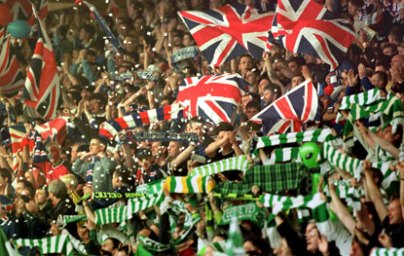
How would this look South of the border?
For as long as Celtic and Rangers have held their seemingly relentless stranglehold on Scottish football, fans both north and south of the border have speculated as to how the Glasgow giants would handle themselves against the top clubs in the English Premiership. The Old Firm over the past decade to 15 years or so have regularly met with English opposition in European competition. These battles of Britain have rarely led to the Glasgow clubs taking a real heavy defeat, which does indicate that they can rough it up with the best, but how would the Old Firm do if English opposition was on the fixture list on a weekly basis?
The truth is we can only speculate, as there is little we can do to identify any kind of common denominator to allow a clear, direct comparison.
The first, well documented factor that puts the respective leagues at polar opposites in terms of stature is TV and prize money. Celtic or Rangers can expect a paltry £2.7m for winning the SPL title this year, while the teams who’ll suffer the cruel fate of relegation from England’s elite division can be comforted by a ‘parachute payment’ of £48m over 4 years. The same disparate revenue totals are echoed when it comes to TV money. The Old Firm will pick up a reasonable few million pounds per year for their troubles in the SPL; but some of the top English clubs are raking in up to £4.3m per televised game!
This almost embarrassing difference allows teams who’re far smaller in stature than Celtic or Rangers to make significant inroads in the transfer market. I’m sure all readers would unanimously agree that the Old Firm dwarf clubs like Bolton, Fulham, Aston Villa or Stoke to name but a few – but just look at the money these ‘wee English teams’ can throw at players.
- Bolton sign David N’Gog for £4.5m
- Fulham sign Bryan Ruiz for £12m
- Aston Villa sign Charles N’Zogbia for £10.8m
- Stoke City sign Peter Crouch for £11.3m
The Old Firm, and Scottish clubs in general can only dream of these budgets. The truth of this hits home when you see Dundee United, one of Scotland’s biggest clubs, bid a miserly £25,000 for Hamilton’s Dougie Imrie, without the means to increase their bid to capture the player’s signature.
Another prime example is the once legendary Fernando Torres. Chelsea splashed an exorbitant £50m on their misfiring striker; a fee that if levied to Rangers in the ongoing HMRC tax case could be enough to force the club into liquidation (hypothetically speaking of course).
I firmly believe that if given the lavish financial buoyancy aids that come along with the Premiership, the Old Firm would be a force to be reckoned with, but again, it’s just a speculative thought in the seemingly infinite cyberspace cosmos that is the football forums of Twitter, Facebook and social media in general.
So, an alternative means of comparison is necessary. An altogether more simplistic one. The crystal clear comparison created by the monitoring of clubs’ ability to put bums on seats.
In Scotland, England, and across Europe as a whole, for decades upon decades, the clubs with the highest attendance figures tend to celebrate more domestic success than those with smaller crowds. This direct correlation is not relative to circumstance, and does stand up to our cross border comparison.
Celtic and Rangers, despite the shocking state of Scottish football, are still pulling in crowds at a remarkable rate, so much so that the average gates would currently put Celtic and Rangers 3rd and 4th in the English Premier League table in this respect.
| Team |
Average Attendance |
Stadium Capactiy |
% full |
| Man Utd |
74,864 |
75,769 |
98.8% |
| Arsenal |
59,927 |
60,361 |
99.3% |
| Celtic |
49,462 |
60,832 |
81.3% |
| Rangers |
45,943 |
51,082 |
89.9% |
| Man City |
45,513 |
47,805 |
95.2% |
| Newcastle |
43,388 |
52,339 |
82.9% |
| Liverpool |
42,864 |
45,276 |
94.7% |
| Chelsea |
41,439 |
42,449 |
97.6% |
| Sunderland |
40,355 |
48,707 |
82.9% |
| Aston Villa |
38,573 |
42,783 |
90.2% |
| Everton |
36,725 |
40,157 |
91.5% |
| Tottenham |
35,794 |
36,230 |
98.8% |
| Wolves |
28,366 |
29,303 |
96.8% |
| Stoke |
27,162 |
27,500 |
98.8% |
| Norwich |
26,515 |
27,033 |
98.1% |
| Blackburn |
25,428 |
31,154 |
81.6% |
| Fulham |
23,909 |
25,478 |
93.8% |
| West Brom |
22,199 |
26,500 |
83.8% |
| Bolton |
21,881 |
28,101 |
77.9% |
| Swansea |
19,822 |
20,532 |
96.5% |
| Wigan |
18,006 |
25,133 |
71.6% |
| QPR |
17,024 |
18,360 |
92.7% |
However, the statistics also bare out that Celtic and Rangers would see a significant rise in attendance figures if they ever did play in the Premiership. Looking at the SPL as a whole, on average, a whopping 43.6% of seats are empty. This figure is heavily skewed by the smaller clubs in the league; if we judge it purely on matches at Celtic Park and Ibrox, the empty seats figure shrinks to just 14.4%.
The story in the Premiership is somewhat different as you’d expect. Across the board in the EPL, you’ll find just 8.8% of seats are empty. If we assume that by playing in the Premiership, the Old Firm saw a similar level of ticket uptake (conservatively estimating the aforementioned calculated 5.6% increase between the leagues) the approximate average attendance at Celtic Park would jump to 52,232 with fixtures at Ibrox being 48,007. These figures put the Glasgow clubs even further afield of the likes of Manchester City, Newcastle, Liverpool, and Chelsea; but still considerably short of Manchester United and Arsenal at the summit of the Premiership. Surely it’s more than just a coincidence that those clubs with the highest attendance figures are the clubs who, buy in large, are fighting it out for the illustrious crown that is the English Premier League title?
Supposing entry was ever granted to the Premiership, Celtic and Rangers would be given an equal share of the over inflated TV money, putting them on an even financial playing field with the rest of the teams. This would make the Glasgow clubs a much more viable option for the top players in Europe and beyond, as the Old Firm could engage in an evenly matched bidding war with any of the other English Premiership club, with the added draw of the huge crowds, legendary atmosphere, adoring fans, and largely incomparable history.
The international brand identity and marketable commodity that Celtic and Rangers possess perhaps may not be as grand in scale as Manchester United or Liverpool currently; but it dwarfs the bottom 10 clubs in the Premiership, and is at least on a par with the likes of Manchester City, Chelsea, Spurs, and Arsenal in my opinion.
Given the opportunity to compete in what’s billed as ‘the greatest league in the world’ by many, would see the Glasgow clubs (after a few years of bedding in) replicate the attendance table positions in the actual league standings.
The Old Firm have everything that a global footballing giant would need, except the financial galvanising that a league like the Premiership offers. The remarkable history and the passion of the adoring fans who turn out in phenomenal numbers, together with the abundant budgets that come as part of the EPL, would almost certainly see Celtic and Rangers challenge for honours with the very best England has to offer.
Sadly though, it’s not as simple and as straightforward as this. Now, and for the foreseeable future, Sky television hold all the cards in this stagnant game of poker. As the Scottish game continues to dwindle and the English game reaches financial saturation, we can but hope that those who call the shots at the television companies come to realise that the royal flush they’re in search of, lies north of the border in the heart of Glasgow.
Have your say – vote in the poll or comment below.


 Hit The Byline