Extending An Olive Branch to Jorge Cadete

Is it time to kick-start a support network for ex-Celts?

by Celtic fan, Kes Devaal

Thanks to the boom & bust world we live in, all too frequently we’re hearing of people from all walks of life falling on financial hard times. At the tail end of last week, we learned that even former Celtic superstars aren’t exempt from this peril.

Jorge Cadete scores for Celtic
He puts the ball in the netty – Jorge Cadete at his peak

When the news broke that Jorge Cadete is now flat broke, moved back in with his parents, and living on benefits, I felt saddened.

As a Celtic fan, I remember Cadete’s playing days fondly, but I was shocked to see an element of the Hoops’ support reacted bitterly towards his misfortune. Comments on blogs and social media sites showed that there is a contingent of Celtic supporters that feel the manner in which Cadete left the club in some way justifies the player’s hardship now.

This is not the Celtic way, and I’m beginning to think that the club (both fans and officials) should look to create a support network for ex-players.

It was the late, great, Tommy Burns who brought Jorge Cadete to Celtic, back in the mid 90’s. Burns inherited a wounded Celtic who were limp competition to a dominant high spending Rangers side. The fans suffered through the disappointment and turbulence of the Brady and Macari years, but Burns injected hope and excitement back into Celtic with a flamboyant style of play, and by attracting players with the boisterous dynamism of Jorge Cadete.

The fact that this period yielded limited silverware seemed almost insignificant at the time, as our beloved Celtic were back, scoring goals, playing lucid, attacking football, and for the first time since the late 80’s, challenging a stellar Rangers side.

Cadete arrived at Celtic with a CV that failed to fill Hoops fans with optimism. The Sporting Lisbon striker was on loan at Brescia, and managed just a single goal for them in a calendar year, before Burns made the move to bring him to Celtic. He hand’t kicked a ball in 5 months, yet his debut against Aberdeen was unforgettable…

The Portuguese international came off the bench to net the fifth in a demolition of Aberdeen at Celtic Park, and went on to net 34 times in 44 appearances the following season. Cadete was easily the most exciting Celtic striker since the days of Brian McClair and Charlie Nicholas. Complete with iconic spaghetti haircut and unmistakeable celebration, and goals-a-plenty, Cadete soon became a hero.

I appreciate that the nature of Cadete’s departure at the time left many Celtic fans feeling a bit raw and generally let down, so it’s understandable that some might want to stay detached from his unfortunate circumstances. I also appreciate that it’s a players responsibility to manage their money responsibly during their career. That said, it has made me ponder about what clubs can do, in particular, Celtic.

Wouldn’t it fit perfectly within the ethos of Celtic to put in place a structured support scheme to guide and support former players who’re in danger of falling on hard times?

By this I don’t mean writing cheques to further line their pockets, but investment advice, emotional support and an ongoing relationship with the club that could mutually benefit Celtic, the fans, and the former player.

The subsequent years since Cadete’s time at the club have been joyous for the most part. The magic of players like Cadete and managers like Burns played a huge part in the evolution of the club, a part that we must never forget.

Without question there have been thousands of Celtic fans down the generations who’ve carried the charitable/goodwill torch for the club with unconditional service. There are too many legitimate examples of this to mention, and that in the main remains intact. My concern is that there is a growing undercurrent of the Celtic support being selective.

In my opinion I sense there is a ‘pick & choose’ mantra amongst the Celtic diaspora of which ex Celts receive our support . Celtic Football Club, and the fans are relentless in broadcasting our proud all inclusive charitable ethos.

The mixed response to Jorge Cadete’s sad news however conflicts with that notion. There is a long list of ex-Celts whose careers at Paradise have maybe ended awkwardly, or where they have been a shade economical in engineering a sharp exit down London Road for more money elsewhere. Yet for reasons that remain unclear, these individuals seem immune to any criticism or hard feelings from the support.

Without sounding like some idealistic moral crusader,  I believe these servants to the club deserve a support mechanism. Making initial support, training, and professional advice available for them would show the football world that we genuinely are what the morally rich club that we say we are.

The relationship between the fans and the players we take on as heroes is a true loyal bond that stays with us for the entirety of our existence.

If Celtic truly are up there with Barca to be considered as “Més que un club” (More than a club), then perhaps we should start to prove it with gestures such as this one, showing undeniable and unconditional compassionate support.


Transfer Embargo Breaking Hearts

It’s time to let the Jambos sign players again

By Johnny Connelly

As the crippled Edinburgh club continue to battle against the odds on what feels like oh so many fronts, a glimmer of hope has emerged for their beleaguered fan base, as the SPFL board ponder a plea from Hearts’ administrators to allow them to sign players again.
Gary Locke’s side sit 20 points adrift at the bottom of Scotland’s elite division with just 16 games to go. They are fighting tooth and nail in every match, but when you look at the threadbare and inexperienced shell of a playing squad they have at their disposal, it’s clear that the club (and particularly the fans) have been punished in a draconian manner.

Tynecastle Stadium
A club in crisis – Hearts are amid their toughest fight yet

Unless the SPFL revoke this transfer embargo, Scotland will almost certainly lose one of its biggest clubs via relegation to the Championship. What a sorry state of affairs for this SPFL season if the status quo remains in place. We’re only halfway through January, and you could safely assume Celtic will run away with the title, and Hearts will fall foul of relegation. Unless something outrageous happens, the second half of our currently sponsorless Premiership is in danger of being a damp squib.

Understandably, rules and protocols are there to be followed; but with the evolution of our game, they’re arguably there to be challenged and improved upon too. Barely a season goes past without a handful of proposals at least being discussed. Everything from summer football to disciplinary procedures is up for discussion, and we’ll continue to fashion our game into an improved product over time.

There are always exceptions to any rule, and given the bizarre circumstances surrounding the downfall of Hearts, it’s clear that an exception for their transfer embargo should be considered.

Punishing a club for going into administration is understandable. It promotes financial prudence, and makes an example of clubs who’ve been reckless with things like inflated transfer fees, and bloated wage bills.

Hearts went into administration in June 2013, but the club’s finances have been questionable for years, all thanks to the disastrous tenure of Vladimir Romanov. If administration is supposed to be a punishment for a club, then I’d argue that Hearts (staff, players, and fans) have been receiving something of a punishment of sorts for the most part ever since Romanov seized control of the Gorgie club back in 2004.

Despite a spattering of highlights and a positive start in the early days, the Romanov era will long be remembered as one of the most catastrophic and farcical saga’s that any club in Scotland has ever had to endure.

Since going into administration, Hearts have had to unceremoniously part with the lion’s share of their first team squad. The fans have been asked to put their hands in their pockets time after time to keep the club’s hand to mouth existence going, and they’ve done so without question.

They continue to be called upon financially, turning up in good numbers and in strong voice to support their club its hour of need. Gary Locke is currently struggling to get enough bodies together to fill his starting 11 and subs bench. Just a few free transfers in January (perhaps  the likes of Rudi Skacel or Andrew Driver) could make all the difference, and could give the Jambos a sporting chance of surviving in the Premiership.

Yes, the fans have been punished by way of administration, but they’ve been suffering all along since 2004. Sporting integrity and common sense in this case show that the rules need looked at again, as Hearts’ punishment doesn’t befit their crimes.

Celts in Europe – Was it really so awful?

by Johnny Connelly

Image

As a dejected Celtic side trudged off after a 6-1 skelping against the majestic Barcelona, Hoops fans voiced their anger and frustration at what many of them judged to be an inferior and lacklustre performance by their heroes.

Now that the dust has settled, was it really so awful? Both in terms of the performance on the night, and the effort given in the Champions League overall?

True enough, Barcelona demolished Celtic. Not since 1965 have Celtic conceded six goals in a single match; but on the night, what could have been done to stop the rampant Catalan side?

Twitter, Facebook, and football phone-in frequenters were aghast at Neil Lennon’s team selection, (after the match of course). What a fine thing hindsight is. The most frequent questions asked circulated around the omission of Charlie Mulgrew, Kris Commons, and Anthony Stokes.

I’m sorry, but does anyone really believe that  the inclusion of any of these players would have reigned-in the likes of Xavi and hat-trick-hero Neymar? Celtic were played off the park, in every area of the park. Surely there’s no permutation of Neil Lennon’s current Celtic squad that could’ve changed the outcome of the game? The fact is, when Barca set the heather alight, the best teams in the world struggle restrain them.

If we’re truly honest, Celtic have rode their luck against Barcelona pretty much every time they’ve come up against them in modern history, even when they’ve managed to beat them. Particularly in the last handful of fixtures between the clubs, Barca have had the lion’s share of chances and territorial possession.  Brave, resilient performances from Celtic have helped keep these matches tight, with any defeats being inflicted by the odd goal, but given the gulf between the sides and the control held by the Spanish giants, a heavy drubbing was always a possibility.

The expectation of Celtic fans is for their team to play well, contest every game, and win in style when it’s humanly possible. To achieve what they have in recent times in the Champions League is formidable. As much as this season’s Champions League campaign could be viewed as disappointing, Celtic have in no way been humiliated, when compared with the other  teams that finished bottom of their group in the competition.

Marseille, Copenhagen, Anderlecht, CSKA Moscow, and Real Sociedad for example all finished 4th. Nobody would dispute that these sides are major European entities, so there’s no shame in suffering a similar fate to them.

Although Celtic have previously reached the knockout stages, to do so this year seems to require major financial clout. When we compare Celtic’s first team wage budget to some of the sides that topped their groups, we begin to understand the David v Goliath nature of the task they face.

Celtic pay just over £300,000 every week on wages to their squad. This is by no means miserly, but Borussia Dortmund (top of Group F), pay almost three times as much. Chelsea pay more than six times more than Celtic in terms of wages, and Barcelona pay an astonishing, 11 times more than Celtic.

Perhaps a shift in mentality from the fans is required. Sadly, Celtic can’t be the world-beaters they were in the 60’s and 70’s. Since then it’s been a rollercoaster ride. For every triumph against Man Utd, Juventus, and Barcelona; there’s been an implosion against Neuchatel Xamax, Wacker Innsbruck, or Artmedia Bratislava.

Celtic are operating well on and off the field at the moment. A few key signings could give them the edge and excitement they long for. Ok, they won’t win the Champions League anytime soon, but 99% of clubs in Europe are in that same boat.

Crack a smile Hoops fans; your team are cruising to another league title, competing in Europe every year, and living within their means. There’ll be ups and downs; good times and bad. Sit back, and enjoy the ride.

Forster or Hart? Roy decides…

Does Roy Have the Hart to Pick Forster?

By Johnny Connelly 

Image

Manchester City and England’s no.1, Joe Hart, added to his CV of calamity at the weekend by dropping another high profile clanger to gift Chelsea a late winner in the English Premier League.

All the while, Celtic’s man between the sticks continues to cruise through matches at a domestic level, and attract plaudits from all over Europe, most recently for his heroics against AC Milan, Barcelona, and Ajax.

What’s wrong with this picture? Well, for starters, Forster still seems to be about as far away from an England cap as ever.

The question is why? Surely it’s not a simple case of ignorance towards a top athlete because of the league he’s playing in?

Roy Hodgson’s England side have been uninspiring, although admittedly still churning out results in the qualifiers. Lapses in concentration from Joe Hart have historically put England under pressure, and given his current form, is it wise to trust a shaky pair of hands going into Rio 2014?

Who could forget his blunder against Scotland just a few months ago? His fumble against Southampton back in February? His corner flap to give Cardiff their first win over City in August? Or his misjudgement against Bayern Munich earlier in the month?

Any notion of replacing Hart was unthinkable last season, but suddenly the recurring errors have led to more than a few whispers of a less than guaranteed no 1 England jersey and on club form even Manuel Pellegrini is fighting to come up with excuses for Hart in the City goal.

In terms of realistic options for England, they have but three. John Ruddy, Ben Foster, or Fraser Forster. Three top goalkeepers, that much is clear, but for some reason Forster feels furthest away from the no.1 jersey.

There’s only so many times Forster can come up trumps in Champions League games, only to be fed lines like “we’re impressed with Fraser, and are watching his development.” Soon a time will come when the England manager has to come off the fence and make a call on his ability.

To choose Forster above any of the other potential suitors for the England no.1 jersey would be a brave decision. Elements of the English media and support believe their league to be the best in the world, so much so that to opt for a ‘keeper playing in Scotland would seemingly verge on an insult.

Forster has a proven big game mentality, and at just 25 years of age, has a good decade of top level football in him. Neil Lennon backs his goalkeeper to the hilt, and openly admits, “it’ll be impossible to keep the player here when he’s performing like that”.

Spanish star Xavi has also spoken of his admiration for the 6ft 7inch goalkeeper. The Barca talisman said: ‘I can’t say that I watch him every week – but when we have played Celtic he has shown that he is a world-class goalkeeper.

‘From what I have seen he has everything to succeed at a club like Barcelona – and with his Champions League performances for Celtic I am sure there will be more than one big club interested in him.’

All interest now turns to England’s upcoming friendlies with Chilie and Germany in November. The squad will be confirmed in the next few days, and given the non-competitive nature of the fixtures, Hodgson will never have a better chance to call-up or feature Forster, with little or nothing at stake.

Brave decisions by managers can be the difference between success and failure. Will Hodgson be brave enough to rise above the false stigma of the Scottish game to select Forster? We’ll find out soon…


Scott Brown: A Worthy Celtic Captain?

by Johnny Connelly

Back in 2007, then Scotland Under-21 coach Rainer Bonhof warned that Scott Brown, despite his obvious talent, “needs to be calmed to avoid disciplinary problems”.

Almost seven years on, the German’s words seem to have gone unheeded.

On the one hand, Scott Brown displays all the qualities of a world-beater. He’s 110% committed, is full of pace, tackles hard, will run all night for his team, has an infectious personality, and presents a considerable attacking threat.

Sadly, there’s more.  There’s a seemingly unshakeable petulance too. So severe is this negative aspect of Brown’s play that it’s undermining his ability, so much so that some Hoops fans are beginning to wonder if the dynamic midfielder is even fit to wear the captain’s armband.

Image
Moment of madness: Brown kicks out at Neymar

Frustration, disappointment and anger resonated around Celtic Park in midweek when Scott Brown, in a moment of madness, foolishly swiped at Neymar, resulting in a straight red card, and the disintegration of any hopes Celtic had of taking any points from the Catalan giants.

Until that point, in keeping with Brown’s Jekyll and Hyde behaviour, the Scotsman was one of the best Celts on the park. His tireless running and positional discipline made life difficult for Barca. Celtic were always facing the improbable, but when Brown lashed out, the improbable became impossible.

Given the importance of the Barcelona match, surely a failing on the part of the captain in this way should set alarm bells ringing in Neil Lennon’s head. The role of captain at any club is a great honour, and is usually bestowed upon only those with the utmost levels of integrity and ability to lead the team on all fronts. Can you imagine the likes of Paul McStay, Tom Boyd, or Danny McGrain kicking out at Neymar in such a prestigious match? It just wouldn’t have happened.

This, when added to Brown’s back catalogue of petulant bookings and repeatedly taking the bait when befaced with a confrontational scenario surely makes his tenure as captain questionable. Impressive performances and a gutsy swagger will get you far, but there’s more to it when it comes to being handed the captain’s armband at a big club.

Lennon must know in his heart of hearts that Brown’s behaviour is unacceptable. Barca match aside, Brown’s name has been thrown in to match reports in Europe for negative aspects in Celtic’s two other big European games so far this season. Another petulant foul against Shahktar Karagandy, and a clumsy, off the ball incident against AC Milan (leading to the deciding goal), add to and underline the question marks around Brown’s professionalism.

It is understandable that Lennon doesn’t criticise his players in a brazen manner, but from his comments about the Brown incident, it seems as though he genuinely believes the player’s actions were justifiable.

The likes of Giorgios Samaras could fill in nicely as captain, and is debatably a better candidate. It’s clear that Celtic can’t afford a liability in the Champions League. They may get away with silly fouls and sloppy play against SPFL opposition, given the gulf in class between Celtic and the rest of the pack; but in the Champions League, Neil Lennon’s men are invariably the underdog, and would be punished for handing the opposition any ill-gotten advantage.

Brown is a terrific player, but how long are the fans and the manager expected to put up with reckless behaviour? The Hoops captain isn’t a budding, raw, rough around the edges project anymore. He’s a grown man, he’s the captain of Celtic, and Scotland.

Now’s the time to start acting like a captain.

Bring on the English! – After Brave Scots Lose At Wembley, The Tartan Army Want A Rematch!

by Johnny Connelly

Scotland players applaud the crowd after a 3-2 defeat against England at Wembley
So near, yet so far. Scots have come a long way in a short time…

12 years, 8 months, and 29 days had elapsed since Scotland last took to the field against our auldest of enemies on the football field; but when the players lined up, the national anthems boomed out, and the kick-off finally arrived, the excitement and passion around the match was so overwhelming that it was hard to imagine how the sides had ever been kept apart.

An explosion of energy right from the word go was a welcome change for the long-suffering Tartan Army. Gordon Strachan’s side, psychologically charged by the deafening noise from the 30,000 travelling supporters, the players lay siege to the England side, battling far harder than we’ve been used to seeing in recent years. It was always going to be an uphill battle, and nobody in the football world gave Scotland a hope against the highly ranked England, yet the Scots managed to take the lead on two occasions, before eventually succumbing to a 3-2 defeat.

Both the euphoria of putting the ball past Joe Hart twice; and the agony of watching Ricky Lambert’s bullet header crash into the top corner leaves the Scotland fans with a gaping hole to fill, a hole that can only be filled by the promise of another chance to take on England again in the near future.

The powers that be surely must see the light and put this fixture back into the diaries of both FAs on a regular basis.

The positives we can draw from having an annual or bi-annual match against England are too great to ignore.  Speaking on Peter & Roughie’s Football Showlast week, former Scotland ‘keeper Alan Rough stressed the importance of the annual Scotland v England fixture back in his day: “It gave the players something to aim for. Everyone wanted to play in that game.”

Roughie’s point is an excellent one. In a time where we’ve seen players ‘retiring’ from international football, withdrawing from the squad with debatable injuries, and at times showing apathy towards the prospect their own involvement in the Scotland setup, a focal point such as the prospect of getting a crack at England on a regular basis could be enough to get them interested in Scotland again.

Scotland lost the talents of Kris Boyd, Barry Ferguson, Kris Commons, and Steven Fletcher (albeit temporarily) prematurely for a variety of reasons. The disappointment of not reaching major finals may have led some players to feel as though representing Scotland in lower profile matches and friendlies is somewhat meaningless. With no focal point to aim for, it’s understandable to see how this mentality could creep in. The psychology of a player can be a difficult thing to unravel. We’ve seen it 100 times before in the domestic side of the game: players will continue to fight hard and produce top performances in league matches that would be otherwise meaningless, if the club still have a cup final scheduled to take part in later in the season.

A match against England every year or two could be our cup final.

It’s nothing short of scandalous that England and Scotland have been kept apart for so long, and it’s a minor miracle that they’ve never drawn each other in the qualifying groups for World Cups or European Championships. Celtic captain Scott Brown donned the captain’s armband for his country against England, but had he been injured or unavailable, a player like Brown may never have played against his country’s greatest rivals. Brown was just 14 when Scotland played England in 1999, surely it’s only right that the best players we produce get to showcase their skills in what is the biggest grudge match possible for the country? Can you imagine Manchester United never playing Manchester City again? Or Barcelona and Real Madrid waiting 14 years for another ‘El Classico’? Everyone in football would be worse off for it.

As much as almost 13 years is a long time to wait to face England; our wait to reach the finals of a major tournament has been longer still. France 98’ is but a distant memory, Gordon Strachan and everyone at the SFA has a responsibility to do everything in their power to give us the best chance possible of reaching a major finals within the next few attempts. England always qualify, it’s just the way it is. A regular match against them could help our campaign, as it’d serve as a barometer and progress marker, year on year (or every two years).

Our road back to reaching the finals of major tournaments will be a long one, so measuring our progress in a tangible manner is key. England’s performance in major finals is fairly stagnant, and as such serves well as a way of measuring how far away we are from being good enough to qualify.

The timing of these matches could aid us too. World Cup and European Championship qualifying campaigns can be long and arduous. Those big 6 month gaps between competitive matches for Scotland can’t be conducive to forming and maintaining a cohesive unit, capable of challenging for qualification. There’s only so much you can learn from the likes of the recent friendly against Luxembourg. When compared to the heated nature of our 3-2 defeat to England, it’s plain to see that as a team, we benefit more from the experience of being pitted against our neighbours.

Away from our immediate qualification and progress goals, current manager Gordon Strachan made a great point about the financial benefits that could be harnessed from a regular Scotland v England fixture. It’s no secret that developing young players, and getting things right for both Scottish and English players from an early age is an expensive task in this day and age. It’s for this reason that Strachan suggested ploughing all the benefits from the annual or bi-annual match directly back into the grass roots of UK football. Wednesday night’s match attracted around 90,000 to Wembley stadium, before we even look at the TV money involved, we’re talking about gross revenue of £3,150,000 from ticket sales alone. This match could easily raise around £10m for grass roots football, and that’s money that our game could put to very good use.

It remains to be seen whether or not the powers that be will bow to the snowballing pressure from fans both north and south of the border to make the match a regular occurrence, but even if we don’t get the action we’re looking for, we’ve come a long way under Strachan. The team look passionate about playing for their country, and the fans are beginning to believe that we can take on anyone, regardless of stature. Strachan’s infectious attitude and personality is under the skin of the nation.

Just a few months ago we wouldn’t have wanted a regular shot at England for fear of the skelping that could ensue. Now, after our victory in Croatia, and a spirited performance at Wembley, Scotland’s lion is well and truly rampant once more.

Bring on the English.


The SPFL – Fan Fuelled Evolution

by Johnny Connelly

(As hosted on http://www.plzsoccer.com/news)

It’s been a long, long time coming, but we’ve successfully reformed the structure of our professional football league format in this country. It’s all kicking off this week, and not a minute too soon.

That arduous, seemingly never-ending string of weeks where we find ourselves with a gaping football hole to fill is almost at an end. We kid ourselves that pre-season friendlies, and even old Youtube clips of bygone years will anesthetise us throughout the summer, but the truth is, nothing but the real McCoy will do. In Scotland, the fans need football; but more importantly, the football needs fans.

This interdependency has never been more apparent than it is now. The dark cloud of doom that lurked over Rangers throughout the Craig Whyte/Charles Green/liquidation saga served as a stark warning that all clubs can fall victim to the perils of the business aspects of the modern game. Yet, at the other end of that turmoil, we saw glimpses of the finest element of our game, the unwavering and unquestioning support of the fans.

Clubs in our country have been plagued by problems of their own, but we’re fighting through it together as football fans. The news this week that Dunfermline’s long standing threat of liquidation could be at an end is huge shot in the arm for our wavering game. The fact that the CVA came from ‘Pars United’, an ordinary group of Dunfermline supporters, further enhances the remarkability of this particular happy ending.

Image

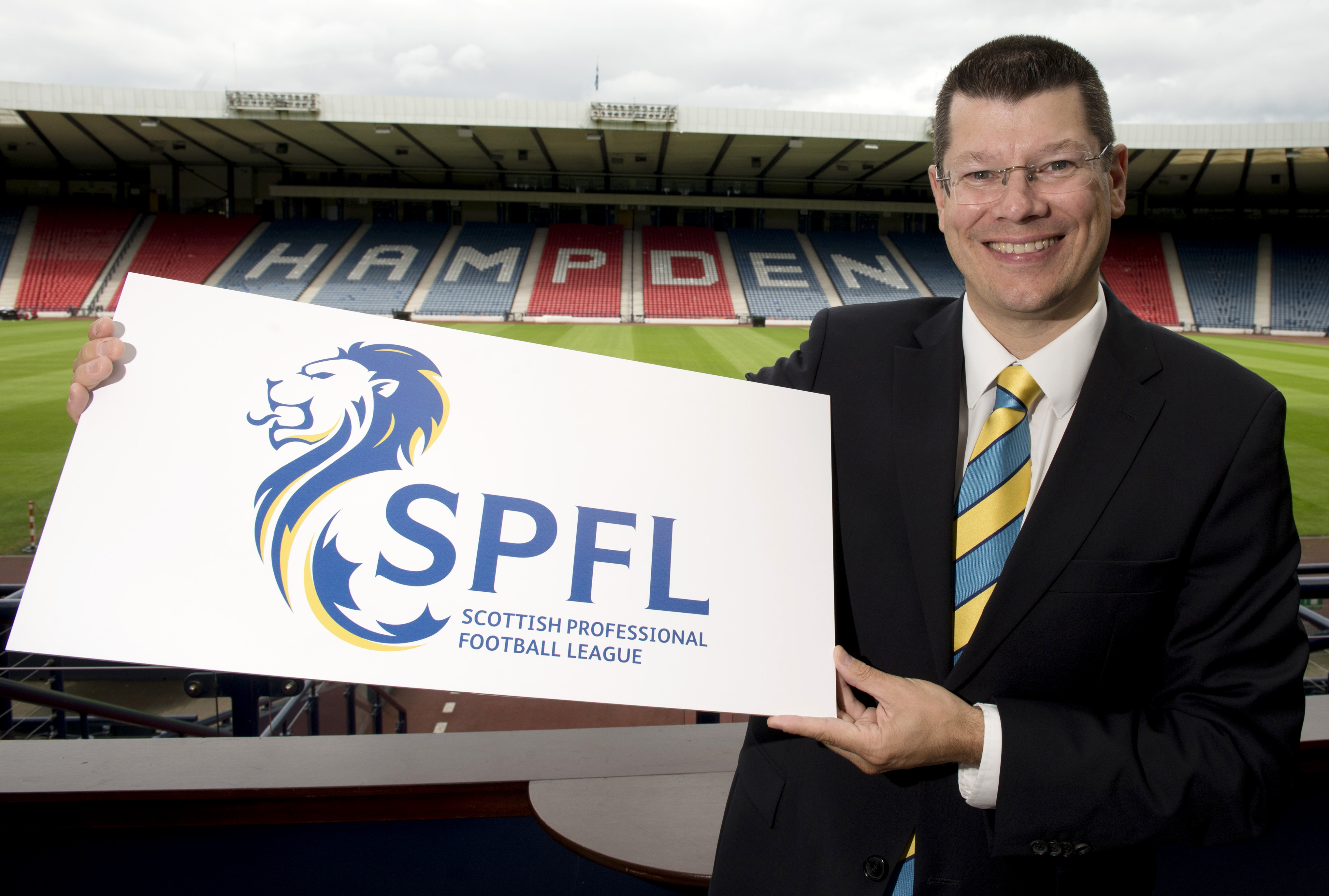
The New Way – Neil Doncaster showcases the new SPFL logo at Hampden

As we prepare to embark upon the new dawn that is the SPFL, it becomes apparent that fan power is more important than ever. Last season was resplendent with hints that the fans will have the final say when it comes to football in this country.

Last season we saw something of a siege mentality at Ibrox, as Rangers fans flocked to support the team in their darkest hour. Attendance records were challenged, and dare I say it, the much maligned Glasgow club seem to be through the worst of their troubles, all thanks to the fans.

Similarly, Dunfermline looked doomed just weeks ago, probably more so than Rangers, but the collective presence of likeminded fans have all but saved their club, albeit through the means of a CVA and by virtue of an empathetic set of creditors.

The SPFL’s big focus now should be channelling energy into finding a solution for Hearts. They too will sink or swim based on the actions of their fans. The effort and commitment so far from the Hearts fans has been overwhelming, and if they could somehow meet the desired monetary amounts to satisfy the creditors, we’d be witnessing a miraculous escape for one of our country’s most revered clubs.

Clubs defying the odds to survive thanks to fan power are perhaps somewhat sensationalised examples of what the common punter can achieve in the world of football. We can however, step back and see that the fans have the power to make the new SPFL a success, despite the apparent downgrading of our domestic game since the days of Larsson, Laudrup, De Boer, and Sutton.

As fans, we’ve faced debacles like the Setanta deal and uncertainties galore, yet here we are, on the brink of another glorious season. Excitement is cascading across the country in anticipation of the big kick off. Yes, there’ll be more problems, and yes, it’s far from the polished product that our neighbours across the border take in every weekend, but it can still be glorious in its own inimitable way.

Small steps are being taken in the right direction all the time. It’s looking positive for the start of the season, as there’s no clearer indication of support than a rise in season ticket sales. 7 of the 12 SPFL Premiership clubs have reported increases in season ticket sales so far, and another 3 SPFL Premiership clubs say their sales are on a par with last season.

Even without the presence of Rangers in our top division, the clubs do have something to attract their fans this season. Celtic, Motherwell and St Johnstone have a taste of European football. They’ll be looking to maximise their involvement this term, and ensure they get to participate again next time around.

Ross County and Inverness Caledonian Thistle will strive to continue their meteoric rise, challenging for 2nd place in the Premiership this season perhaps? Hearts, Hibs, Dundee United and Aberdeen will seek to right the wrongs of last season and finish in a position that befits their club stature; while St Mirren, Kilmarnock, and the new boys Partick Thistle will be well aware they’ve been touted to go down, so they’ll have fire in their bellies, and a will to escape the drop.

The road back to the big time for Scottish football is a long one, we may never get back to where we were, but football in this country is a labour of love. We’ll forever indulge in nostalgia, we’ll forever exaggerate the glory days, and we’ll forever dream of a product better than the one we current showcase.

Our excitement for football is insatiable, there’s nothing quite like those start of the season butterflies. This time around, we’ll take the bad news with a pinch of salt and remember that football is for enjoying.

It may not be perfect, but it’s our league, and we love it.

SPL/SFL Merger: Progress at last or a gamble we can’t afford?

By Johnny Connelly

At long, long last, a majority of SPL and SFL clubs have come to an agreement on the future structure of our domestic leagues. In a wrangle that felt equally as long-winded as the Rangers v HMRC tax debacle, a breakthrough was reached as 23 clubs voted in favour of new plans that’ll see the creation of a single governing body (the SPFL).

Audible sighs of relief (as opposed to the expected hubbub of optimism) rippled through the Scottish football community when this deal was reached. The big black cloud that loomed over our game’s future has been cleared from our skies at least temporarily, as we can now look forward a new exciting format that boasts financial redistribution, as well as the reintroduction of playoffs.

As much as I’m pleased to see the end of this, I can’t help but think back to the massive overhaul in structure that the fans and the clubs cried out for. The new, 12-10-10-10 structure just doesn’t match up to these demands in my eyes. If we look initially at the SPL and SFL Division 1 clubs, as far as I can see (playoffs aside) all that’ll change is the distribution of wealth amongst them.

Image

When two become one – The SPL and SFL will be replaced by the SPFL


I see this as something of a gamble, although I do understand the strategy. Make some of the top placed teams in the SPL suffer financially in the short term, so as to financially boost the bottom placed clubs in the SPL and the rest of the SFL initially, and create a more holistically-centric, financially viable league structure in Scotland in the long-run.

The logic is sound, but we must hold our hands up and admit that it is a gamble of sorts. This process would be the golden ticket to revamping our game domestically if all the current SPL clubs were financially bloated, but we all know this isn’t the case. From a moral and idealistic standpoint, throwing money at the 1st Division clubs is without a doubt the right thing to do. It shows that the powers that be are thinking about the game’s success in the long term; but to disregard the threat this scheme poses to the top SPL clubs is foolish.

Here is how the money is expected to be redistributed throughout the current SPL and SFL Division 1 clubs:

SPL
1: £2,405,514 (13.39%, -£314,487)
2: £1,717,454 (9.56%, -£682,546)
3: £1,460,555 (8.13%, -£59,446)
4: £1,288,629 (7.17%, -£71,371)
5: £1,202,757 (6.7%, -£77,243)
6: £1,116,884 (6.22%, -£83,116)
7: £1,056,701 (5.88%, -£63,299)
8: £1,005,142 (5.6%, -£34,858)
9: £987,895(5.5%,+£27,895)
10: £902,023 (5.02%, +£22,023)
11: £816,150 (4.54%, +£16,150)
12: £730,277 (4.07%, +£10,277)

First Division

1: £386,248 (2.15%, +£318,248)
2: £343,132 (1.91%, +£276,132)
3: £300,016 (1.67%, +£234,016)
4: £256,900 (1.43%, +£191,900)
5: £240,731 (1.34%, +£176,731)
6: £188,633 (1.05%, +£126,633)
7: £172,464 (0.96%, +£111,464)
8: £154,499 (0.86%, +£94,499)
9: £138,331 (0.77%, +£79,331)
10: £120,366 (0.67%, +£63,366)

This looks good in theory. If we take only the top two Divisions into account, we see that 8 clubs will suffer initially, while the remaining 14 benefit substantially. The 2nd and 3rd Divisions tell a similar story, with some smaller clubs standing to make an additional £46,000 a year, while any decrease of revenue for clubs can be as little as £80.

However, the likes of Motherwell punch above their weight, on a shoe string, with a threadbare squad. Every penny counts for them, yet if this structure was in place last season, despite them miraculously finishing 2nd Scotland’s elite division, the Lanarkshire club would be £682,546 worse off. This, although nothing compared to the money that the giants of European football are throwing around, is still significant when we put it in context that it would almost double the losses made by the club, bringing them up to a combined loss of over £1.2m for the season.

This year’s 3rd and 4th placed clubs would be dealt a similar hand, although not quite as severe. St Johnstone would have been almost £60,000 worse off for the year, and Inverness Caledonian Thistle too would be down by over £71,000. Again, these figures mean nothing without context, but when you see that St Johnstone have made six-figure sum losses in three of the last four seasons, that £60,000 becomes a sum of money that’s not to be scoffed at. Terry Butcher’s Inverness Caledonian Thistle too run on a shoe-string budget, but this projected loss of £71,000 represents around 18% of the club’s current overall debt.

On the other side of the coin, how can we be sure that the right clubs are benefitting if all we’re going on is their final league position over a season? Take Queen of the South for example. This season they cruised through the Scottish Second Division, thanks to a larger budget amongst other things. Under this new structure, the team in the 2nd Division that claimed the title thanks to greater financial muscle, would further be enhanced by a winnings pot of £102,401 (an increase of over £46,000 on the previous year).

I suppose we’ll never know how this’ll pan out until we stop speculating, and let it run for a few seasons. One thing that we all seem fully behind though is the revamp and reintroduction of playoffs across all of our divisions. Playoffs guarantee that the season has a focus and purpose, regardless of how far apart the clubs may be points-wise. A final showpiece and crescendo to the season is ensured, which should hopefully dispel the apathy that’s been creeping in over the past few seasons.

This season the SPL has been crying out for a playoff setup. Celtic won the league at a canter; and Dundee went down without a whimper. The whole league was a dead duck by Christmas. At least with playoffs, we’ll have something to get excited about right until the end of the season as teams will have something to play for right until the very last kick, and in all divisions too. The closest thing we had to excitement outside the SPL this season was the Ramsdens Cup final. What a great example of how to achieve excitement in football in a simple way. 10,000 people crammed in to Almondvale for the final, and thousands more watched live on BBC Alba. This proves beyond doubt that although we may not have the quality of the Premiership at our disposal, the route to success for our game in this country lies with generating excitement. Structuring the game correctly is the key to this, and we’ve shown from the likes of the Ramsdens Cup, that excitement trumps quality any day of the week.

My personal preference would have been for a bigger league, and the fans voted in their numbers for this. The fact is that we must bend over backwards to get bums on seats in football grounds all over Scotland. When you achieve that, the desired TV deals could well have followed, as we’d have injected the excitement back into the game that drew crowds, and would spur interest from further afield. Who’s to say this won’t happen in the future, but for now I’m happy that a cohesive approval from our top clubs will drive a united front for our domestic game to succeed. The formation of the SPFL could signal the start of a journey towards a prosperous league setup in Scotland, but if it’s to succeed, we must back it unwaveringly. It must be adjusted accordingly to generate as much revenue and excitement as possible, or we could find ourselves in the midst of another moribund spell of ‘reconstruction talks’ again before too long.

Why Celtic must take the money for Wanyama…

By Johnny Connelly

It’s that time of year again when the transfer rumour mill goes into over-drive. Every prized asset from clubs all over Scotland will be touted for a move to a new potential suitor; some, as in Victor Wanyama’s case, will even be linked with clubs in the self-proclaimed, ‘best league in the world’, the English Premier League.

Victor Wanyama celebrates against Barcelona
Wan the man – Victor bested Barca

Wanyama is a wonderfully talented player. He’s composed, pacey, ferocious in the tackle, competent in the air, can pass well under pressure, and has even been known to knock-in the odd wondergoal, but if the reported bids of £10-£12m are true, then Celtic would be mad to hold on to him.

Let’s face it, it’s been the plan all along. The scouts spotted a promising young Kenyan playing for Beerschot AC in Belgium, and the club proceeded to snap him up for a paltry fee of £900,000 with a view to developing him for a couple of seasons, and selling him on for a huge profit. Whichever way you look at it, a potential £12m return on a £900,000 signing is a fantastic piece of business (if it goes ahead of course).

The dangers of rejecting this type of offer are crystal clear. You need only look as far as Emilio Izaguirre to see how quickly a white-hot gem of a player can descend back into mediocrity, taking his alleged £10m-ish price-tag with him. Celtic have to strike while the iron’s hot, behaving like a clever stock broker, buying cheap and selling high. The likelihood is that SPL clubs will never (at least in the foreseeable future) be able to command a transfer fee that exceeds £12m. There’s a glass ceiling in terms of value in the SPL, and Wanyama has hit it.

Players devalue quickly; this is one of the game’s most fickle qualities. As well as current Celts like the aforementioned Izaguirre, I remember the summer of 2001, when a certain Bobby Petta was tearing up defences and skipping past wingers for fun. The Parkhead faithful must have thought they had a world-beater on their hands when Petta, with his accomplice Didier Agathe, produced a phenomenal performance against Dutch giants Ajax in the Amsterdam Arena during a Champions League Qualifier. Petta found the net that night, and continued on to wreak havoc for full-backs who could only look on as the majestic winger left them for dead. At the peak of his powers, Petta’s opposite number Fernando Ricksen, was taken off just 20 mins into an Old Firm Derby where Celtic went on to famously win 6-2.  Petta even secured a call-up to the Holland squad, and caught the attention of Paris St Germain. A £3m bid ensued, which Celtic of course rejected. With the gift of hindsight, this proved to be a foolish move. Petta’s form dipped, and the cult hero spent much of his remaining few years at Celtic Park on the sidelines, blighted by injury.

Not to suggest that Wanyama isn’t a better player than Bobby Petta, but if Celtic could turn the clock back and take the £3m, there’s not a supporter in the world that’d have stood against it. This, although admittedly an extreme example, could very well happen to Wanyama too.

Yes he’s a fantastic player, but when the grand history of Celtic Football Club comes to be written, I’m sure there’ll be few who’d regard the big Kenyan as indispensable. Neil Lennon seems to be well steeped in the club’s buying and selling policy. He’s been around the club for a while, both as a player and manager; long enough to have learned when to sell on for maximum profit. Since Petta, when have Celtic got it wrong? When have they hung on to a player too long?

Stan Petrov went to Aston Villa for £8m, Aiden McGeady to Spartak Moscow for £9m, and Ki Sung-Yueng to Swansea for £6m. These players were all wonderfully gifted, but they went at the right time, and many would argue that Celtic got the best years out of them.

When a top player leaves, the club always becomes stronger in their absence. When Celtic defeated Barcelona at Celtic Park last season, nobody was thinking that the team missed a McGeady, Ki, or Petrov. Wanyama will be no different, despite his talents and commendable attitude.

The plan was to sell on Wanyama, right from the start. The dream scenario is always to unearth a gem on the cheap, develop the player, enjoy their talents for a few seasons, then sell on for an exponentially larger sum than they paid to acquire the player’s services.

There’s no debating the logic. Celtic can’t generate large profits solely from winning competitions in Scotland. Champions League TV money and selling on young players, while operating within a strict wage budget is the only sustainable business model for the club. The likes of Gary Hooper, Emilio Izaguirre, Beram Kayal, Joe Ledley and Fraser Forster were signed with the same long-term goal in mind, although not everyone would admit it.

The plan doesn’t always work out, but if 1 in 3 players develops into a potential £10m transfer, then the scouts at the club will have successfully completed their task, and the club can reinvest in youth to start the process all over again, while achieving domestic success, competing in Europe, and most importantly, exciting the fans along the way.

Is the penny finally dropping for Ally?

McCoist looks as though he’s learned lessons from last year’s flops

The long suffering Rangers fans of the modern era will no doubt continue to have their club dragged through the dirt in the coming season as more and more details of the Craig Whyte & Charles Green cavalcade of misdemeanors and skulduggery come to the fore. Sadly these club issues will wrangle on, but the last few weeks have had a silver lining of sorts on the actual football side of things, as Ally McCoist has made some impressive signings straight off the bat since the controversial transfer embargo has been partially lifted.

Rangers Manager Ally McCoist
Stern of face – McCoist has his work cut out for him

The past and continued involvement of Charles Green and Craig Whyte is a matter for the courts, and is well out of the fans and McCoist’s hands, but it would appear that there are signs of life as the manager has wasted no time in pressing on with strengthening his squad for life in Division 2, with one eye clearly on shaping a team that could compete in Division 1 and the SPL.

Gers fans haven’t had much to smile about over the last few years, broadly speaking, but the latest 4 players to join Rangers should bring a smile to even the grumpiest of supporters.  Although Rangers cruised to the Scottish 3rd Division title, even the most devoted of fans grew weary of the performances (or lack of) being put in by some of last season’s signings. A distinct shift in signing policy was required; and it looks as though it’s being delivered.

The likes of Fran Sandaza and Ian Black were never going to be wise choices to slot into a Rangers side facing a gruesome fight in the Scottish 3rd Division – for very different reasons of course. Sandaza, although a gifted goal scorer, has never been the most energetic player. His lethargic style of play led to him being a divisive character at Dundee United, and generally unpopular during his short spell at Brighton. There’s no doubt that he can stick them away when given a decent supply; but when be faced with a muddy park, playing against hard-nosed joiners and labourers who’d like nothing better than to put you on your backside, his effectiveness soon diminishes.

Ian Black too has struggled to win over the Ibrox faithful. He succeeds where Sandaza fails in terms of endeavour, but his blatant lack of ability and over-reliance on a style of play that borders on thuggery leaves him well short in terms of credentials to hold down a place in the Rangers midfield.  Of course there have been glimpses of promise from the likes of Dean Shiels and David Templeton, but the overall style and standard of signing has been lacking from a long-term perspective.

McCoist has wasted no time in securing the services of 3 top SPL players and a 40-goal striker from Queen of the South. Jon Daly, Nicky Law, and Cammy Bell have been joined by Nicky Clark as Rangers look to take the 2nd Division by storm.

Jon Daly is no spring chicken at 30 years of age, but with a goal tally of 58 from 167 appearances for Dundee United available on a free transfer, McCoist would be a fool to turn him down. Again in stark difference to Sandaza, Daly can throw his weight about and isn’t afraid to mix it up when it comes to tackling hard. His vast experience in England’s lower divisions while playing with Stockport, Bury, Grimsby, and Hartlepool will be drawn upon again as this same grit and determination will be required to guide Rangers up through the divisions here in Scotland.

Cammy Bell was something of a surprise when you consider Rangers already have a quality keeper in Neil Alexander. Ongoing contract debates with Alexander, and a propensity to concede goals due to lapses in concentration last season have clearly lead his manager to look for alternatives. In Scotland’s lowest division, Alexander managed just 12 clean sheets in matches where Rangers picked up all 3 points. Cammy Bell has his best years ahead of him at just 26 years of age, and could easily hold on to the no.1 jersey when Rangers eventually return to the SPL. His impressive performances over the last 7 years for Killie even led to peripheral inclusion in the Scotland setup. Bell will be around for a while at Rangers if he plays his cards right, but will come under the same scrutiny as Alexander if he fails to hit the ground running.

The acquirement of Nicky Law’s signature caught everyone off guard. Law was at the heart of the Motherwell midfield this season as they punched above their weight to finish 2nd in the SPL.  He’s attracted attention from the Championship, and reports even linked him with SPL Champions Celtic, so a move to the Scottish 2nd Division, albeit with Rangers, was a surprise to everyone. At just 25, he too could remain as a first team pick for McCoist when the club get back to the big-time. He’s shown himself to be strong in the tackle, but with a decent engine to go box to box, and with the ability to split defences with a clever pass. Law has cut his teeth in England’s lower divisions, having spent time with Sheffield United, Yeovil, Bradford, and Rotherham. He’ll be one to watch for Rangers this season and beyond, if his performances last season were anything to go by.

Away from the SPL, Queen of the South striker Nicky Clark also joined the ranks at Ibrox this week. McCoist shattered the delusion that Rangers would simply be cherry picking players from the SPL, as he opted for Clark who shone in the 2nd Division and Ramsdens Cup last year. He rattled in 40 goals last season, and knows only too well the pressures of playing for Rangers if he’s been listening to his father, Sandy Clark. It’s fair to say he’s not proved himself at the highest level, but finding the net 40 times in a season at just 21-years of age makes him a hot prospect for the future. It’ll be interesting to see if he can replicate or better his tally this season, given the increase in pressure brought on by playing for a bigger club.

Given the way the last 3 years have gone, we know that there’ll be more twists and turns to come in this seemingly never-ending saga of ownership, debt, EBTs, title deeds, liquidation, and every other sensationalised story that’s landed at the gates of Ibrox in recent times, but credit must be given to McCoist on this occasion for competently dealing with the task at hand – strengthening his squad. The road back to the big-time for Rangers will be a long and arduous one, and if success is to be achieved, then McCoist will need to deliver the right type of performance from the right type of signing. The real pressure starts now, and his latest signings will be expected to explode into action next season.